
Home / Property Types / Hotel Management Software
For independent & business hotels
Hotel management software that runs the whole property
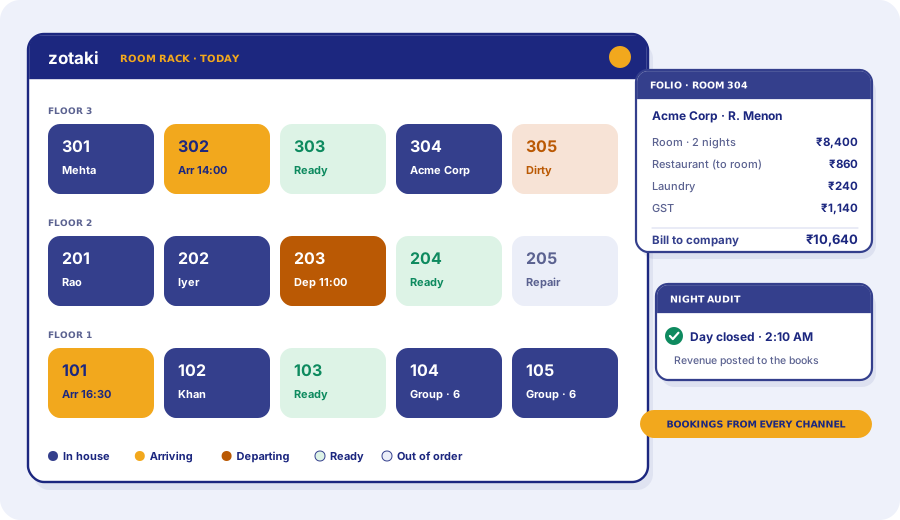
A hotel runs rooms, a restaurant, events and a set of books, and most software only covers the first. Zotaki puts front desk, housekeeping, restaurant billing, banquets, a booking engine and accounts on one platform, with the OTA channel manager as an add-on, so every charge lands on the right folio and every report agrees.
Features at a glance
Everything a hotel runs, in one system

Front desk & reservations
Room rack, walk-ins, check-in with ID capture, folios and GST invoices.

OTA channel manager
Rates and availability synced with 19 OTA channels, as an add-on on every plan.

Commission-free booking engine
Direct bookings on your own website, from Zotaki Reach onward.

Housekeeping app
Room status updated from a phone, so ready rooms reach the desk at once.

Restaurant & room service
KOTs and outlet billing, with charges posted straight to the guest's room.

Banquets & events
Hall calendar, function sheets and per-plate menus for every event.

City ledger & accounts
Company and travel-agent billing and ledgers, with Tally integration as an add-on.

Owner dashboard
Occupancy, ADR and revenue for today, on a phone, without phoning the desk.
The daily reality
Why hotels end up running five systems
Bookings arrive from the website, the OTAs, travel agents and the walk-in at the counter. The restaurant bills on its own machine, the banquet diary lives in a drawer, and the accountant rebuilds the month from printouts. Every gap between those systems is where revenue leaks and the front desk improvises.
- Double bookings when an OTA is updated by hand
- Restaurant bills that never reach the guest's folio
- Company bills chased from a separate register
- Night audit skipped, so the day never really closes
- Owner numbers compiled from WhatsApp every morning

Built around how you operate
How Zotaki fits a hotel operation
Corporate & agent accounts
Negotiated rates, bill-to-company folios and a city ledger that shows who owes what, and since when.
Restaurant charges on the folio
A dinner or room-service order posts to the guest's room, so nothing is settled from a separate register at checkout.
Groups and functions
Block rooms for a wedding or conference and run the hall, menu and advances in the same system.
GST done once
Slab-wise tax on rooms and F&B separately, HSN/SAC on the invoice, and GST reports your CA can use.
Night audit that closes the day
One routine closes the business date, posts revenue and gives the owner a number they can trust.
Room to grow
Add a second property, a restaurant or a banquet hall later without moving to another system.
The complete guide
Hotel management software, explained
Eight systems, a dozen vendor names for each, and a category where the words are used so loosely that two quotes are rarely comparable. This is the map — what each system does, how they connect, which ones your property actually needs, and where to start if you currently have none of it.
- The PMS is the centre. Everything else feeds it or reads from it.
- Nearly every property needs three things: a PMS, a channel manager if you sell on OTAs, and a booking engine if you have a website.
- F&B and banquets are the fork in the road in India — most PMS products stop at rooms.
- Vendors use these words loosely. Ask what is included rather than assuming.
- Start with the PMS and channel manager. Add the rest when you feel their absence.
What the term actually covers
Hotel management software is an umbrella term rather than a product. It covers every system a property might run, from the front desk to the kitchen store. Vendors apply it to whatever they happen to sell — which is why one quote covering "hotel management software" can mean a full platform and another can mean a room chart with a booking form.
At the centre of all of it sits the PMS. If a property owns one system, it is that one. Everything else either writes into it or reads from it.

The eight systems, mapped
| System | What it does | Who needs it |
|---|---|---|
| PMS | Rooms, rates, reservations, check-in, folios, housekeeping, reports | Almost every property |
| Channel manager | Two-way sync of rates and availability with OTAs | Anyone selling on OTAs |
| Booking engine | Commission-free reservations on your own website | Anyone with a website worth sending traffic to |
| Restaurant POS | Outlet billing, KOT routing, table plans, charge-to-room | Properties with a restaurant or bar |
| Banquet module | Halls by slot, per-plate menus, priced inclusions, advances | Properties hosting weddings or functions |
| Stores & purchase | Requisition to issue, vendor rates, recipe-linked consumption | Properties with meaningful F&B or a real store |
| Accounting | Receivables, payables, city ledger, departmental P&L | Most properties, at some level |
| Guest CRM | Guest profiles, segments, campaigns, loyalty | Properties wanting repeat direct business |
Two more appear in vendor lists and are worth naming so you recognise them: revenue management (pricing intelligence, genuinely useful only if someone has time to act on it) and a hotel website module, which some vendors bundle and others leave to an agency.
How they fit together
The connections matter more than the individual products, because that is where things break.
| Connection | What flows | What happens if it fails |
|---|---|---|
| Channel manager → PMS | OTA reservations, modifications, cancellations | Bookings typed by hand; overbookings |
| PMS → channel manager | Rates, availability, restrictions | Rooms sold that you no longer have |
| Booking engine → PMS | Direct reservations and payments | Direct bookings entered manually |
| POS → PMS folio | Restaurant and bar charges | Charges lost; guests disputing bills |
| Stores → POS | Recipe-linked stock deduction | Food cost cannot be calculated at all |
| PMS → accounting | Revenue, tax, receivables, payables | A fortnight of re-keying every month |
Nobody buys hotel software for the connections. Everybody suffers for them.
This is the real argument behind the all-in-one versus best-of-breed question. Every line in that table is either a feature of one platform or an integration between two vendors — and at an independent property, nobody is employed to notice when an integration quietly stops.
Which ones you actually need
Ordered by how much risk each one removes, which is a more useful ranking than feature count.
- PMS — almost always firstRemoves double-bookings, produces correct invoices, and gives you occupancy and revenue figures that exist without being assembled.
- Channel manager — immediately after, if you sell on OTAsTwo OTAs plus walk-ins is already three places the same room is sold. This is the piece that prevents the expensive mistake.
- Booking engine — once the first two are workingThe commission saving is real, but only if you have traffic and a reason for guests to book direct.
- Restaurant POS — if you have outletsDecide this at purchase rather than after go-live. Retrofitting F&B onto a rooms-only system means running two systems permanently.
- Banquets — if functions are real revenueIn India this is frequently underestimated. A hall sold by slot cannot be modelled as a room type.
- Stores and accounting — as the property growsBoth become worthwhile when the numbers are large enough that guessing costs more than measuring.
- Guest CRM — when you have a guest base worth workingA few hundred past guests is enough to make a lapsed-guest campaign worth sending.
By property size
| Property | Genuinely needs | Can wait |
|---|---|---|
| Homestay, 4–8 rooms | Calendar sync if listed on OTAs, simple invoicing | Nearly everything else |
| Guest house, 10–20 rooms | PMS, channel manager, GST invoicing | Banquets, stores, CRM |
| Hotel, 20–50 rooms | PMS, channel manager, booking engine, POS if there is a restaurant | Revenue management, loyalty tiers |
| Resort with F&B and lawns | All of the above plus banquets and stores | Enterprise reporting suites |
| Small group, 3–10 properties | Multi-property PMS, central reservations, consolidated reporting | Per-property duplicated systems |
| Hotel, 100+ rooms | The full stack, plus revenue management if you employ someone to use it | Little — at this size most of it earns its place |
What the whole stack costs
Worth stating plainly: for most independent properties, the software is not the expensive part of running a hotel. OTA commission typically costs several times the annual licence, which is why a commission-free booking engine changes the arithmetic more than a cheaper PMS does.
When comparing quotes, put them on the same basis — licence, onboarding, per-user charges, per-channel OTA fees, per-booking commission and the modules you will need in year two. See how to compare properly.
Where to start from nothing
If your property currently runs on a register and an OTA extranet, the sequence that causes least disruption:
- Write down your five hardest workflowsBefore you see a demo. They are your test script for every vendor.
- Get the PMS and channel manager live firstTogether, because they are most useful as a pair and they remove the biggest risk.
- Set rate plans up properly at the startThis is the decision that determines whether every report you ever run means anything.
- Run alongside your register for a weekNot forever — a week. Long enough to build confidence, short enough that nobody keeps two records permanently.
- Add the booking engine once the basics are habitThen give guests a reason to use it, or it will convert nobody.
- Add F&B, banquets and accounting as they earn their placeUsually in that order, and usually a few months apart.
Five mistakes worth avoiding
- Buying rooms-only, then discovering the restaurant. The most common and most expensive sequencing error in the Indian market.
- Letting the team book on typed "special" rates. It saves ten seconds and destroys every report the system will produce.
- Comparing year-one licence prices. Onboarding, per-user and per-booking fees frequently exceed the licence difference.
- Assuming "integrates with" means "works with". Ask what specifically flows, in which direction, and how often.
- Skipping the night audit. A week of skipped audits takes far longer to untangle than a month of running them.
Frequently asked questions
What is hotel management software?
An umbrella term for the systems a hotel runs on, with the PMS at the centre and the booking engine, channel manager, POS, banquets, stores and accounting around it.
Is it the same as a PMS?
Not quite — the PMS is the core system within it. Vendors use both terms loosely, so ask what is actually included.
Which systems does a hotel actually need?
Almost every property needs a PMS. Add a channel manager if you sell on OTAs, a booking engine if you have a website, F&B if you have outlets.
One platform or several products?
For independents and small groups, one platform usually wins because nobody maintains integrations. See all-in-one vs best-of-breed.
What does the whole stack cost in India?
Roughly ₹8,000 to ₹60,000 a year for an independent property as one platform. See Zotaki pricing.
PMS versus channel manager?
A PMS runs the property internally; a channel manager faces the OTAs. The channel manager feeds the PMS and cannot run a hotel alone.
Do small hotels need all of this?
No — see software for small hotels for what a fifteen-room property genuinely needs.
How long does implementation take?
A few days to two weeks on a cloud platform, mostly spent on room types, rate plans, taxes and OTA connections.
Can it handle multiple properties?
Cloud platforms generally can — one login, central reservations, consolidated reporting. See multi-property management.
Where should I start?
PMS and channel manager first, then the booking engine, then F&B and banquets if your property has them.
Related guides
See your own hotel running on Zotaki
A 30-minute live demo on your own property type. Online setup, training and unlimited support included.